It's all about the customer journey and the customer experience in omnichannel retail.
Clienteling in Practice: A Luxury Retail Example
Like pretty much every woman I know, there's one bag that's been on my wishlist forever: the iconic Chanel 2.55 flap bag. I made myself a deal: hit goal X, and I'd buy myself that bag. The first time I saw it in person, fully intending to buy, was ten years ago in the Dubai Mall. You walk in and get a warm welcome, a glass of Roederer champagne, and they bring out bag after bag for you to try. I loved the experience, but it was still a splurge, so I didn't buy it that day. It didn't come off the wishlist, though.
A few years later, I was shopping in Amsterdam and stopped by Chanel. It was crowded, so I signed up on an iPad at the entrance and they texted me when it was my turn. I was already in their CRM at that point, though I didn't think about it that way then. A lovely woman greeted me, offered the same glass of champagne, and we sat down. She asked about what I was looking for, and I'm pretty sure she clocked the dupe Chanel shoes I had on. She came back with the bags I wanted to try, patiently helped me through all of them, and even brought out the real shoes for me to try alongside the bag.
I left with both. She added my receipt to my account for future questions or repairs, added me on WhatsApp so I wouldn't have to queue next time, and signed me up for exclusive events. Every couple of months I get a catalogue and tailored messaging. I genuinely feel seen by the brand, and I want to be part of the community.
Mapped to the sequence above: the iPad sign-in was the unified-record capture. The in-store conversation and WhatsApp follow-up were clienteling. The catalogue cadence and tailored messaging were loyalty and personalized messaging working together. Every layer depended on the one before it.
That's the experience this piece is about building, for one customer here, and for all of them at scale below.
One Data Layer, Four Capabilities
Every brand and retailer is chasing the same goal: meaningful, lasting customer relationships. Transactional loyalty still works, but the real momentum has shifted toward community and clienteling. You can't deliver that experience consistently if your customer data is scattered across disconnected systems, a website login here, a loyalty card from an external partner there, separate email platforms, separate activation tools. The relationship belongs at the center of the system, not fragmented across the edges of it.
Foundation: Unique Customer View and Architecture
Definition: A unique customer view is a single source of truth for every customer, one unified account across your ERP and POS, covering every transaction and touchpoint, online and offline.
This is the foundation every layer below depends on. Once customer data is clean and unfragmented, you can segment audiences, send personalized messages, and deliver offers that feel seamless across channels, because they're drawing from the same record instead of four disconnected ones.
Technical note: this can be securely linked to an SSO provider to stay GDPR-compliant. EVA supports login via any OpenID provider. In practice, this means a customer who logs in once online can be matched to their in-store profile without a second account, which is the same mechanism that made it possible for the Chanel associate to pull my profile from an iPad sign-in.
Layer 1: Clienteling
Definition: Clienteling is the practice of giving store associates a real-time, unified view of each customer so every in-person interaction feels personal rather than improvised.
Instead of juggling disconnected systems, your team gets one foundation for spotting opportunities and delivering personalized experiences at scale, the same foundation that let a Chanel associate know what I'd tried on before, without me repeating myself.
Layer 2: Loyalty Program
Definition: A loyalty program built on a unified customer record means every point, tier, and promotion works consistently across every touchpoint, instead of resetting at each channel boundary.
A strong customer database is the backbone of any loyalty program worth running. Connect it to your commerce and customer data, and loyalty stops being a separate system bolted onto checkout.
Layer 3: Personalized Messaging and Ads
Definition: Personalized messaging uses real-time transaction and behavior data to drive genuinely individual communication, email, SMS, WhatsApp, social ads, push, rather than generic blasts to broad segments.
This is the layer that turned my Chanel experience into an ongoing relationship: not a single great visit, but a catalogue and tailored messaging that kept arriving afterward.
Layer 4: Hyperpersonalization with AI
Definition: Hyperpersonalization is AI-driven personalization at the individual level, rather than the segment level using purchase history, browsing behavior, style preferences, and shopping timing to generate messaging, recommendations, and offers tailored to one person.
Segment-based vs. individual personalization:
Segment-Based | Individual (AI-Driven) |
|---|---|
Same offer to everyone in "loyal customers" | Offer tailored to one person's purchase history |
Sent on a fixed campaign schedule | Sent at the time that person is most likely to open it |
One tone for the whole segment | Tone matched to how that person has engaged before |
In practice, this looks like a follow-up message recommending the exact items that pair with what someone just bought, sent at the time of day they're most likely to open it, in a tone that matches how they've engaged with the brand before.
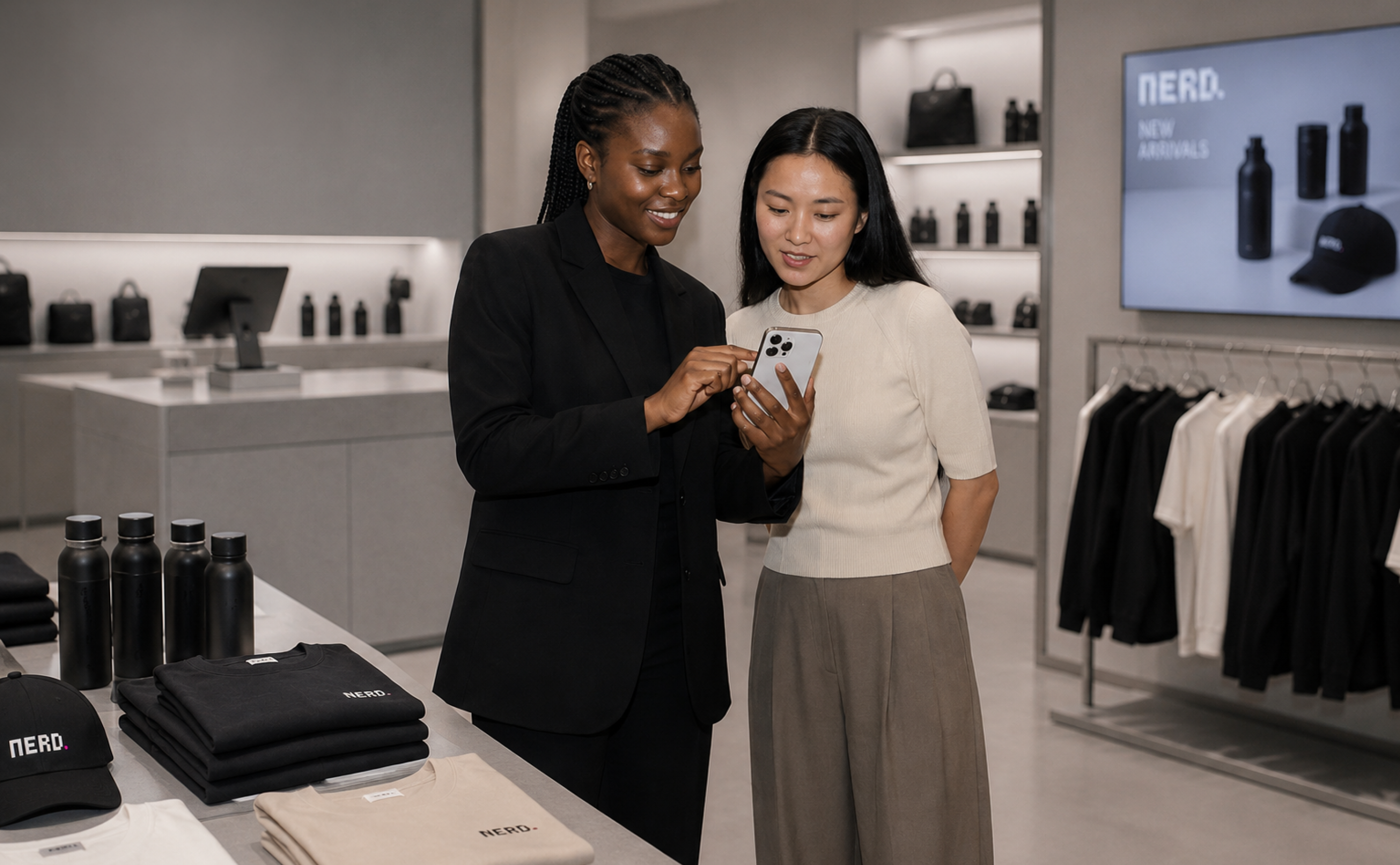
It also extends to the store floor. A clienteling app can surface a quick summary the moment a loyal customer walks in: recent purchases, sizing preferences, items browsed but not bought, and suggested talking points, built from the same unified record, so the associate isn't scrolling through a CRM for five minutes first.
AI use cases on the marketing side, specifically:
- Generating personalized email and ad copy variations at scale
- Predicting churn risk typically by flagging drops in purchase frequency or engagement against a customer's own historical baseline, rather than a fixed segment average, so outreach happens before the relationship goes cold
- Identifying micro-segments a human wouldn't spot manually, such as customers who buy from new arrivals within 48 hours of a drop and respond well to early-access offers
The result: every customer feels like the brand knows them, not because a human individually crafted every message, but because AI does the heavy lifting on top of a clean, unified foundation, freeing the team to focus on the moments that matter most, like the kind of in-store experience described above.
The Point of the Sequence
One customer, one afternoon in a Chanel boutique, is easy to deliver, a good associate and a glass of champagne can do it. The harder problem, and the one this piece is actually about, is delivering that same feeling to every customer, automatically, without a small army of staff who happen to remember everyone's shoe size. That's only possible in the order laid out above: unify the record, then build clienteling, loyalty, and messaging on top of it, then let AI do at scale what a single skilled associate does for one customer at a time.