Why Do Loyalty Programs Fail Even When Customers Redeem Rewards?
Because redemption is not attachment. A customer who hits a points threshold and cashes it in has completed a transaction, not formed a relationship. The Recognition Ladder explains why, and what is still missing.
The brands doing this well right now are not offering more discount. They are offering something harder to find: a sense of being in on something. Discovery. Recognition. The feeling of belonging to a smaller group that knows something the average customer does not. Each of the four examples below maps to a different rung of the Recognition Ladder.
Anticipation Through Algorithmic Opacity: Nike's SNKRS App
“This is the Anticipation rung in practice: Nike has built a system designed to be uncrackable.”
Nike’s SNKRS app has an invite-only feature called Exclusive Access. Certain members get the chance to buy coveted drops before the general public. The criteria for selection are deliberately kept vague. Past losses are one factor. But the exact ingredients shift constantly, and Nike is upfront about it: working out the formula and trying to influence it will not improve your odds.
That is a brand telling its customers the system cannot be cracked. Rather than frustrating people, it creates obsession. You keep the app downloaded. You keep notifications on. The invite might come at any moment.
Nike also hides drops in the physical world. Some launches are geo-located. Others unlock when you scan augmented reality targets or scratch-able images in the wild. The drop becomes a scavenger hunt. Participation, regardless of whether you win, deepens the relationship.
This is loyalty built around identity and access, on top of points and tiers.
Anticipation Through Hidden Discoverability: Strava's Buried Challenges
“Strava operationalizes Anticipation differently, through discoverability rather than randomness.”
Strava is a fitness app. Complete challenges, earn badges, fill your trophy case. Simple enough on the surface.
But Strava challenges exist not only on the public listings page. They also sit behind sequential IDs in the URL, meaning a portion of them are effectively invisible to the average user. Discoverable only if you know where to look. Third-party sites have been built by enthusiasts specifically to surface these hidden challenges. The people who find them fill their trophy cases in ways casual users simply cannot replicate.
The badge becomes a signal: not just of effort, but of belonging. You are in the group that knows. And that group, by definition, is smaller than the one that doesn't.
This is not gamification in the shallow sense. Not spin-to-win or daily streaks. It is the feeling of discovery. The sense that your trophy case says something about you that others cannot easily copy.
Identity Over Calculation: Sephora's Rouge Celebration
“Sephora demonstrates the Identity rung: the reward stops being about the transaction and starts being about who you are recognized as.”
Sephora's Beauty Insider program has reportedly grown to tens of millions of members and is widely cited as driving the large majority of Sephora's annual sales. But the most interesting thing Sephora has done is not its scale. It is what it chose to do at the top.
Rouge members spend at least $1,000 a year with Sephora. They could receive a proportionally larger discount for that. Instead, Sephora runs the Rouge Celebration: a four-day event built entirely around exclusives and experiences, with no sitewide discount attached. Sephora's leadership has been explicit that discounting is not the differentiator they're optimizing for. What Sephora is building instead is a different kind of relationship. One where being a Rouge member feels like being a recognisable face in a room most people cannot enter.
Sephora also gives community badges for behaviour that has nothing to do with spending: answering questions, sharing product recommendations, uploading progress photos. The program notices who you are in the community, not just what you have spent.
Identity Through Deliberate Secrecy: Never Fully Dressed's 'Supremely Sassy' Tier
“Never Fully Dressed shows Identity can be built without scale. Secrecy alone creates the signal.”
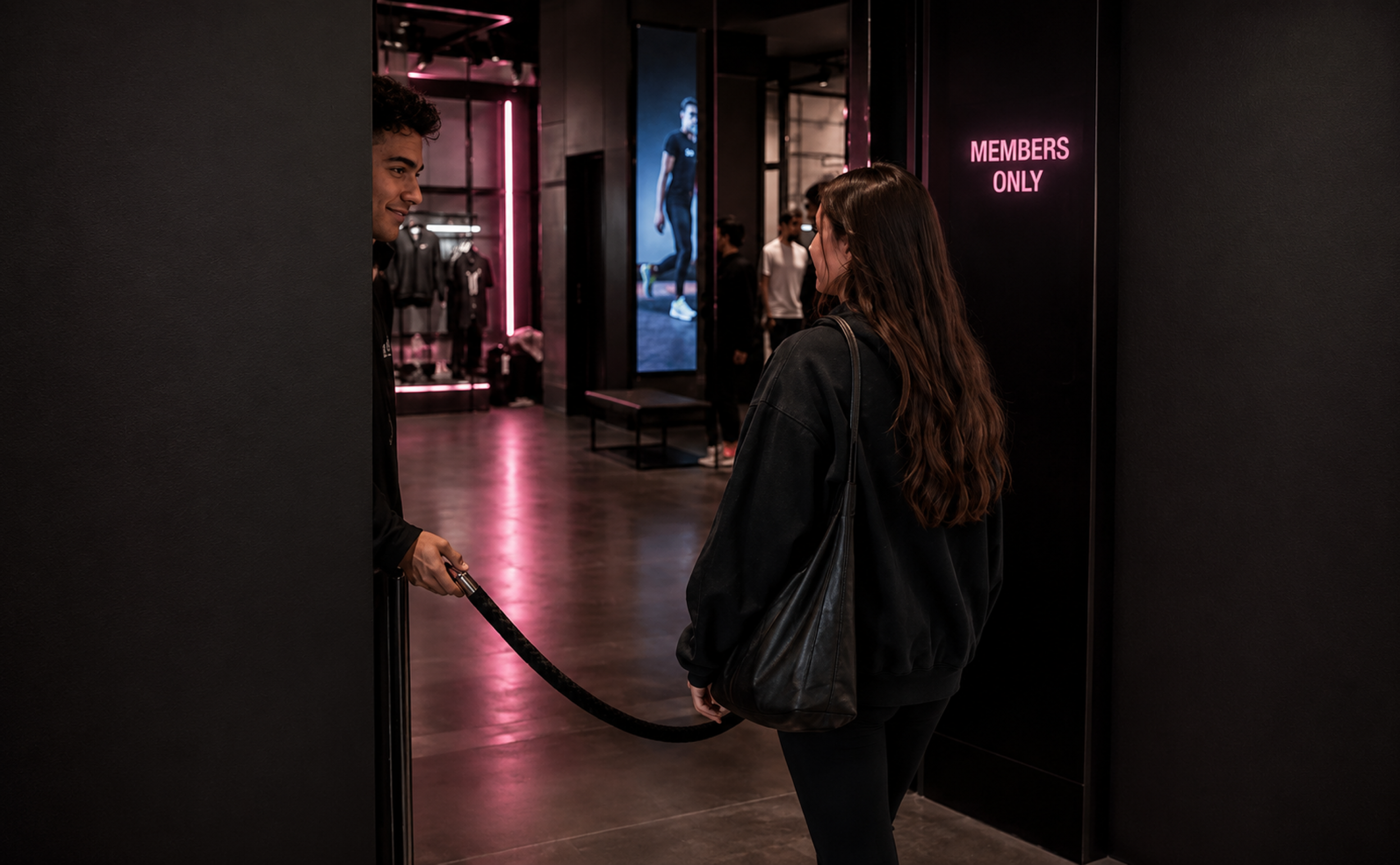
Not every example needs a nine-figure budget. Never Fully Dressed, a UK fashion brand, built a top loyalty tier called "Supremely Sassy" that unlocks access to Secret Sales. Sales the lower tiers do not know about, cannot find, cannot access.
The mechanic is not complicated. But it requires a deliberate choice: make some things invisible, resist the instinct to show all customers everything, trust that secrecy adds value rather than causing frustration.
It does. Exclusivity is the reward, not the discount itself.
When This Backfires
Scarcity only works if it's earned. Two failure modes are common: customers perceive the mystery as manipulation (Nike has faced criticism that opaque selection criteria feel arbitrary or unfair), and lower tiers feel excluded rather than aspirational when secrecy isn't paired with a visible path upward. The Recognition Ladder only functions if movement between rungs feels possible, not rigged.
Moving Customers Up the Ladder
There is a meaningful difference between a reward you can see coming and one you cannot.
When a customer knows exactly what they need to do to earn something, they calculate. They wait until the threshold is within reach. They treat the brand like a vending machine. The relationship is arithmetic.
When the reward is unpredictable, or earnable in ways most people do not know about, the dynamic shifts. Recognition replaces transaction. The customer stops calculating and starts paying attention. That is a fundamentally different kind of engagement, and it is far harder to walk away from than a points balance.
The question for any retailer is whether you are building a program customers only calculate their way through, or one they also feel their way through.
- Make some rewards invisible (Anticipation): The best badges and invitations should arrive before the customer knows they were working toward them.
- Reward behavior, not just spend (Identity): Engagement, advocacy, and community contribution signal genuine attachment, reward them quietly.
- Keep scarcity real (Anticipation/Identity boundary): Artificial exclusivity destroys trust fast. If the badge is rare, it needs to be genuinely rare.
- Let the signal travel (Identity): A Strava badge lives on a profile your training group can see. A Nike drop is something people talk about because others know how hard it is to get.
The choice isn't between a cheap loyalty program and an expensive one. It's not about choosing between Calculation and the climb. It's about building the climb on top of it. Discounts keep customers on the bottom rung. Recognition and discovery move them up it.
How to Tell If It's Working
Redemption rate measures Calculation. To measure Anticipation and Identity, track app open rates between reward events, unprompted social mentions of the program, and the ratio of non-spend engagement (community contributions, content shares) to spend-driven engagement. A program climbing the ladder should show rising engagement even in periods with no active discount or drop.
FAQ
What's the difference between gamification and recognition-based loyalty?
Gamification (streaks, spin-to-win) rewards repetition. Recognition-based loyalty rewards unpredictability and identity signaling. It's harder to game and harder to walk away from.
Does the Recognition Ladder work for small retailers?
Yes, Never Fully Dressed shows Identity-stage mechanics (secrecy, named tiers) don't require Sephora's scale or Nike's engineering budget.
How do you measure whether a loyalty program has moved customers up the ladder?
Track signal-sharing behavior (badges displayed, drops discussed externally) and engagement that isn't spend-driven, not just redemption rates.